The day the high winds knocked out the power, water, and internet we took a trip up the mountain to learn about the coffee process. We could not work and we did not know when the power would be back on. The high winds are new to the area especially when the hurricane season in months away. The weather patterns have changed in the region. Part of what people call Global Climate Change.
The new weather patterns have caused more rains and the rain comes for a longer period of time. This is a picture of an area that had a bad mud slide a few years ago. This mud slide took out the road and it was about a year before it got built back. During that time, to get up the mountain you had to take a bus up to this point, walk across the foot bridge, and take another bus the rest of the way.
This is the foot bridge over the gully. A man was killed working on the new road when the ground gave way and his end loader went down the mountain. The next pictures gives you a better view the area.
I was on the bridge looking down to the small creek bed below. It is deeper than you think. Road can wash away in this area and when you drive it is not unusual to see spots in the road that are gone and need repair.
This blog is a way for me to inform people about the solar coffee bean dryer that we are trying to develop at Illinois Central College.
Monday, January 16, 2012
The view in the morning
You wake up in the morning, sit on the porch, drink your cup of coffee, wait for breakfast, and this is the view that you have to look at. Beautiful flowers, a nice mountain with a small water fall that you can hear. I can see why people like the area. I can see why people go down there to retire. They also have good coffee.
Soda can solar collectors
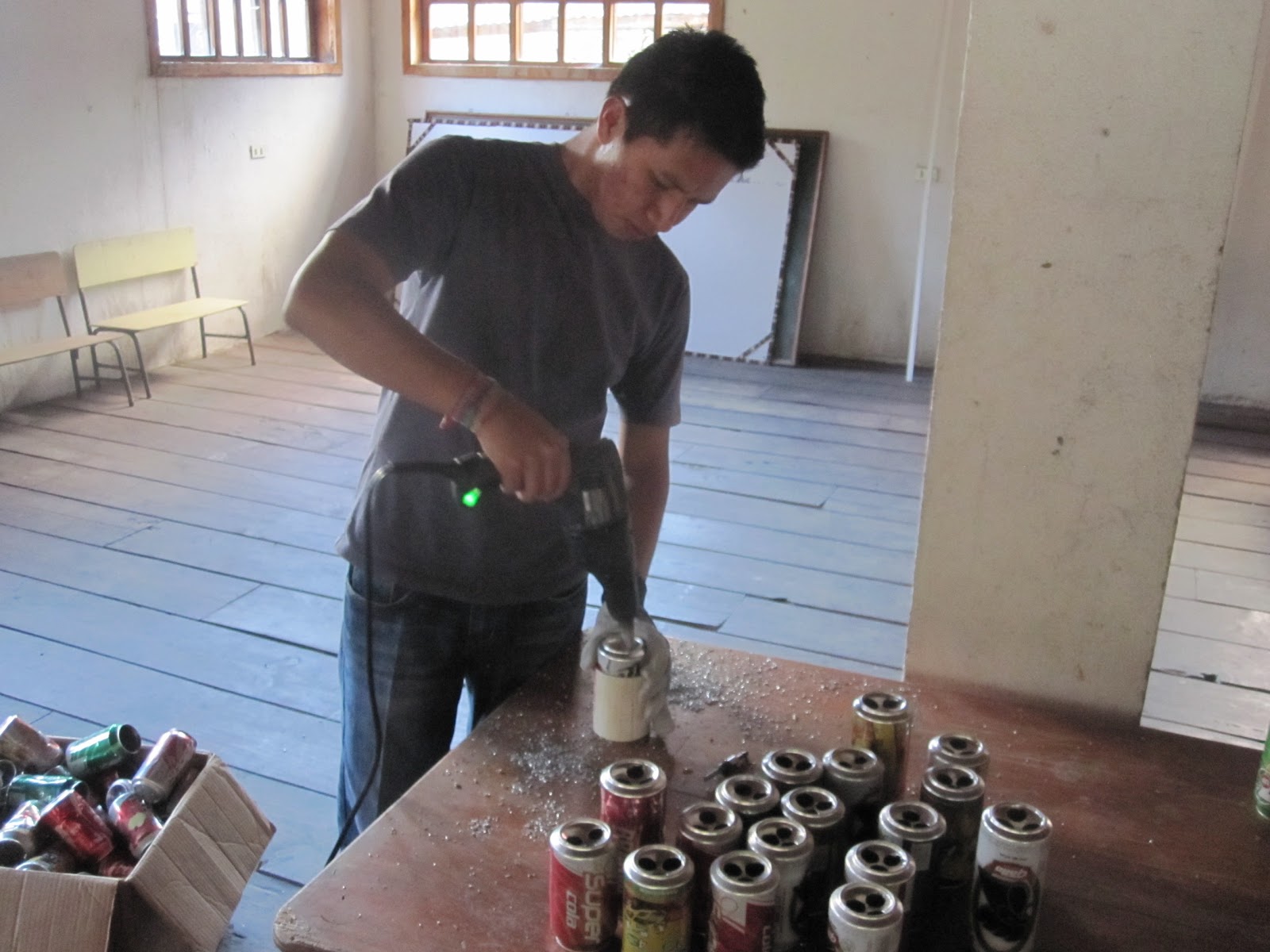
One of the major projects for the trip to Guatemala was to built two soda can solar collectors to show the coffee producers an environmentally friendly way to dry their coffee beans and other fruits and vegetables. Rufino had purchased the building materials and I brought down the needed tools and the fan and fan temperature controls. It is difficult to check a 4x8 sheet of plywood on to an airplane especially now, what with the baggage fees. I also brought down some high temperature silicone caulk and can openers. One of the first problems we had was the can openers that worked so well at cutting off the tops of soda cans in the USA did not work on the same Coke cans in Guatemala. I don't really know what the difference was or why but it was enough that the can openers did not work. That problem did slow down the project. We used tin snips and the old fashion Swiss Army knife type of can openers. Once we got the tops off the cans we drilled the three holes in the bottom of the soda cans.
While one group was working on the soda cans another group was drilling holes in the header that held the soda can in place. We had to measure, mark, and drill the 2 1/2 inch holes used to hold the cans in place. I had brought down several hole saws for this task. We found the Bosch hole saw worked the best. It cost more but was included in a set of four and actually was the better value. The Bosch hole saws would also cut metal.
The cooler air enters the bottom of the collector and as the air is heated by the sun it will rise and empty out the top. We added a fan and a temperature control to aid the coffee bean drying process.
We built the collector frame out of a 4x8 sheet of plywood and 1x6's. The lower header is for the cool air and the top header was covered with sheet metal and then we added a clear plastic over the whole collector to keep out the rain.
Some local visitors heard about this and stopped by to discuss their solar ideas. Andre, the camera man for this project, filmed everything we did. Once everything was complete we moved the collectors outside to apply the black paint. You can see the lower header that is used to allow the cooler air to the enter the collector and the wider top section where the warm air exits the collector.
You can see the colors of the unpainted soda cans at the right hand upper corner. It is surprising how well this simple system works. The collector with the fan had a heat sensor in it that would start the fan once the air temperature in the collector was 110 degrees and the fan would not shut off until the air temperature dropped to 90 degrees. The collectors we built are actually designed for heating homes in colder climates but they do work OK in Guatemala, as we found out. A little bit of time out in the sun and the fan will start up. The fan will stay on even when the sun drops behind a few clouds.
This is just a simple eight inch duct booster fan wired to a temperature control. After talking to the coffee coop people we may just add a simple fan and a speed control and run the fan all the time. The day the high winds knocked out the power and water we went up the mountain to learn about the coffee drying process but that is a story for a different blog. The finished soda can collectors were loaded on the truck and moved up the mountain to the test site.
While one group was working on the soda cans another group was drilling holes in the header that held the soda can in place. We had to measure, mark, and drill the 2 1/2 inch holes used to hold the cans in place. I had brought down several hole saws for this task. We found the Bosch hole saw worked the best. It cost more but was included in a set of four and actually was the better value. The Bosch hole saws would also cut metal.
The cooler air enters the bottom of the collector and as the air is heated by the sun it will rise and empty out the top. We added a fan and a temperature control to aid the coffee bean drying process.
We built the collector frame out of a 4x8 sheet of plywood and 1x6's. The lower header is for the cool air and the top header was covered with sheet metal and then we added a clear plastic over the whole collector to keep out the rain.
Some local visitors heard about this and stopped by to discuss their solar ideas. Andre, the camera man for this project, filmed everything we did. Once everything was complete we moved the collectors outside to apply the black paint. You can see the lower header that is used to allow the cooler air to the enter the collector and the wider top section where the warm air exits the collector.
You can see the colors of the unpainted soda cans at the right hand upper corner. It is surprising how well this simple system works. The collector with the fan had a heat sensor in it that would start the fan once the air temperature in the collector was 110 degrees and the fan would not shut off until the air temperature dropped to 90 degrees. The collectors we built are actually designed for heating homes in colder climates but they do work OK in Guatemala, as we found out. A little bit of time out in the sun and the fan will start up. The fan will stay on even when the sun drops behind a few clouds.
This is just a simple eight inch duct booster fan wired to a temperature control. After talking to the coffee coop people we may just add a simple fan and a speed control and run the fan all the time. The day the high winds knocked out the power and water we went up the mountain to learn about the coffee drying process but that is a story for a different blog. The finished soda can collectors were loaded on the truck and moved up the mountain to the test site.
Saturday, January 14, 2012
Back in the USA
I got back to Peoria last night after spending 13 days in Panajachel, Guatemala. We were able to complete the work that we had hoped to do. I am just making sure that I can use some of the equipment because I need to post more pictures. I had some Internet problems in Guatemala. The Internet is better here. I met some very nice people, some very interesting people, learned about the coffee industry, and I hope to return again some day. I still have a solar water heater that I want to install at the Godinex school. I still have my memories of Guatemala and with a few more days of cream those memories will be gone. They look worse than they are.
Tuesday, January 10, 2012
justt about done
made some changes to the coffee dryer today based on the advice we got from Marvin at the coffee finca. They were very helpful and I know more about coffee now. I just wish the netbook was working. I have pictures to post and coffee to roast. The beans we had today were on the bush two weeeks ago
Saturday, January 7, 2012
shopping for supplies
We needed to get some fittings to make sure we had what we needed to hook up the piping for the solar hot water heater. You would not think it would be that difficult to buy what you need but we did manage to buy them out of half inch copper tubing, all two feet of it. I think we can make it work. I am hoping we can make it work. You just have to adjust to the way things are.
breakfast
I had some of this for breakfast. I am not sure what it is but I know it came from inside a cow. It tasted like a firm liver. It was ok but I wouild not order it at a restaurant. Mainly the breakfast is like what I eat. The only difference is the tortillas and the beans. Today we had eggs and corn meal mush. The only difference is my corn meal mush sets up in a bread pan and they use corn husks.
soda bottle lights or soda bottle sky lights
This is a picture of the first soda bottle light or sky light that we installed in Guatemala. This test was done at Rufino's shed. The soda bottle sky light adds enough light to the room to equal a 60 watt bulb. It can really add light in to a space that is dark. As long as the sun is out you get free light. Many of the small homes here have no windows or one window. If you need to see you have to use electricity so this free source of added light can really help. I would be curious to see what would happen if we added a reflecting shade to it..
This is one of the soda can solar heaters that we built. This model has fan in it that is hooked to a temperature control. When the temperature in the collector reaches 110 degrees the fan starts and moves more hot air in to the coffee drying rack that we built. Our test model is similar to the larger models they use at the coffee coop, or finca. We tested this one today and it was producing warm air. We are going to get another fan for the other unit and a speed control for it. The solar heater in this picture has a fan that will start once the box temperature is 110 and will shut off when the temperature cools to 90 degrees.
We should be able to dry coffee beans on Monday. The coffee coop's water pump is broken. They pump water from the lake up the mountain to the coffee coop. The water is used to wash that beans.
The way I understand it, they pump the water up the side of the mountain from the lake. That is a long haul.
This is one of the soda can solar heaters that we built. This model has fan in it that is hooked to a temperature control. When the temperature in the collector reaches 110 degrees the fan starts and moves more hot air in to the coffee drying rack that we built. Our test model is similar to the larger models they use at the coffee coop, or finca. We tested this one today and it was producing warm air. We are going to get another fan for the other unit and a speed control for it. The solar heater in this picture has a fan that will start once the box temperature is 110 and will shut off when the temperature cools to 90 degrees.
We should be able to dry coffee beans on Monday. The coffee coop's water pump is broken. They pump water from the lake up the mountain to the coffee coop. The water is used to wash that beans.
The way I understand it, they pump the water up the side of the mountain from the lake. That is a long haul.
Wednesday, January 4, 2012
finishing the solar collectors tomorrow
After a good day of work on the solar soda can collectors we headed to town to have some tacos for supper. Today was a good day of work and tomorrow we will finish the two solar soda can collectors and paint them. We should move them up the hill on Friday, build the little greenhouse, and see how much hot air we can produce and if we can dry some coffee beans. We also need to start to work on the solar hot water heater. That should go ok once we get started.
We took a tour of the local open market and bought some snack food and some meat. The local market here is very much like the markets in Xian. Meat, vegetables, fruits, clothes, you name it it is there. Hope to have some good pictures of the greenhouse, the solar panels, and Rufino's town up the mountain.
Tuesday, January 3, 2012
Winding night and no power the next day
We had a big wind storm last night and because of that we were without power and water most of the day. Since we could not do the work we had planned we took a trip up the mountain to learn about the coffee process.
This is the forced air coffee drying process that we are learning about. The large screen at the left of this picture is where the cleaned coffee beans are placed. Hot air from the furnace blows in under the screen and then raises up and through the beans to dry them. This requires a generator for the elecricity and fuel to run the heater. If we can do something with solar we should be able to help cut costs.
This is the more traditional coffee drying patio. The beans are spread out on to a concrete patio and then raked every 30 minutes to make sure they dry evenly. The beans are covered at night and then uncovered in the morning. The coffee takes three to six days to dry. This batch will take about six days because we had some cloudy days. It takes a lot of work to make our morning Jo.
This is a picture of the younger coffee plants on the hillside. I found it difficult to walk up the hill and I would think it would be a lot harder to do it carrying a bag of coffee beans. But if you are picking coffee and decide to turn around you will get to see this view.
This is the reason why some people like to live here.
This is the forced air coffee drying process that we are learning about. The large screen at the left of this picture is where the cleaned coffee beans are placed. Hot air from the furnace blows in under the screen and then raises up and through the beans to dry them. This requires a generator for the elecricity and fuel to run the heater. If we can do something with solar we should be able to help cut costs.
This is the more traditional coffee drying patio. The beans are spread out on to a concrete patio and then raked every 30 minutes to make sure they dry evenly. The beans are covered at night and then uncovered in the morning. The coffee takes three to six days to dry. This batch will take about six days because we had some cloudy days. It takes a lot of work to make our morning Jo.
This is a picture of the younger coffee plants on the hillside. I found it difficult to walk up the hill and I would think it would be a lot harder to do it carrying a bag of coffee beans. But if you are picking coffee and decide to turn around you will get to see this view.
This is the reason why some people like to live here.
Monday, January 2, 2012
first full day of work here in Guatemala
First full day of work on the solar collectors we had some people stop by to compare ideas with us. Part of what we are here for is to do the work, teach Rufino how to do the work, and to document the work that we are doing. Andre, an ICC student from Russia, is the film person on this trip.
Rufino and Dr. Kellerman are drilling the holes on the board that is to hold the soda cans in place and allow the warm air to move through them.
We are cleaning old soda cans so that we can cut the tops off and drill holes in the bottom of them.
Drilling holes in the bottom of the cans. Next step is to glue them together and mount them in to the frame we have built. We had a few problems with the cans because the cans here are just different enough from the cans in the USA. We had to get the tops off using tin snips. You have to adapt.
We are having a snack of fruit for the morning.
Lunch. You put the stuff on the plate in the bowl of soup. It was very good. Paty Cole has a cook book that was put together by the local ladies, just like every church does in the Midwest. We should be able to photo copy it and take the recipes back to the USA and share them with the ICC culinary department. We can also share them with our new friends in Silver City.
Out on the town for a nice supper. Met some people from Santa Fe, New Mexico. The reason we started to talk was because she had a Starved Rock State Park sweat shirt on. I was wearing my Sancken Automotive tee shirt and quite a few people asked me to say Hi to Honest Mark. I did find out that Rufino's wife, who is called Irma, has a traditional Guatemalan name. Irma in Guatemala is pronounced Ear-ma. That is why I thought it was strange that she was named Irma because I thought of it as an English name and it is not. It is really windy tonight and I hope it calms down. This is the coldest month here and so far it has been nice weather. Tomorrow we should have a soda can collector done and be working on another. Watching the bowl game on the TV.
Rufino and Dr. Kellerman are drilling the holes on the board that is to hold the soda cans in place and allow the warm air to move through them.
We are cleaning old soda cans so that we can cut the tops off and drill holes in the bottom of them.
Drilling holes in the bottom of the cans. Next step is to glue them together and mount them in to the frame we have built. We had a few problems with the cans because the cans here are just different enough from the cans in the USA. We had to get the tops off using tin snips. You have to adapt.
We are having a snack of fruit for the morning.
Lunch. You put the stuff on the plate in the bowl of soup. It was very good. Paty Cole has a cook book that was put together by the local ladies, just like every church does in the Midwest. We should be able to photo copy it and take the recipes back to the USA and share them with the ICC culinary department. We can also share them with our new friends in Silver City.
Out on the town for a nice supper. Met some people from Santa Fe, New Mexico. The reason we started to talk was because she had a Starved Rock State Park sweat shirt on. I was wearing my Sancken Automotive tee shirt and quite a few people asked me to say Hi to Honest Mark. I did find out that Rufino's wife, who is called Irma, has a traditional Guatemalan name. Irma in Guatemala is pronounced Ear-ma. That is why I thought it was strange that she was named Irma because I thought of it as an English name and it is not. It is really windy tonight and I hope it calms down. This is the coldest month here and so far it has been nice weather. Tomorrow we should have a soda can collector done and be working on another. Watching the bowl game on the TV.
Saturday, December 31, 2011
Our last meeting before we leave
Dr. Kellerman held a meeting to go over the important items of the trip, before we take off for Guatemala. I am looking forward to the trip and think we should be able to get our busy schedule of work done. I think we will be able to get our busy schedule of work done and with the tools we will leave behind the people of the area should be able to continue to build solar panels, if they decide the panels will work for them. I hope the solar hot water heater works out well. I will continue to take solar energy classes at ICC during the spring semester. The solar energy is much easier to install when you do not have to worry about it freezing.
These are the two students that will be making the trip to Guatemala. Andre, the student on the right, has the main duty of filming the entire project. One of the important jobs is to document what we are doing and using that film to help sell this project to others once we get back to ICC. We are going down there with what we think we will see and what we think we can do and that is all based on having never been there. The more information we bring back the more ideas we can get from other people about what we might be able to do in the future to improve things for the people of the area. Ben, the student on the left, will do what ever we need him to do, gather information, build solar panels, work on plastic bottle walls, and be a good ambassador for our school and our country. Like any trip I have nothing much to do now but to wait until we leave. This is the part I do not like, the waiting to leave. I have my bags packed and weighed, so that is done. I had that done a couple of days ago. I am glad we have a driver taking us to the Chicago airport. It makes everything so much easier. I guess the next post will be from Guatemala.
Monday, December 26, 2011
new post from my new phone
I guess I can post things from my phone now. I will also have to learn how to do pictures and other things that you can do with a better phone. I am slowly joining the 21 century. But I have a lot to learn.
My new smart phone
I am going to see if I can post something on this blog using my new phone. I need to learn how to live in the new world that electronics has created for us. I still can not see me walking around with a phone stuck to the side of my face but I will need to learn how to use it because we are going to give up our land line as soon as we move to Silver City. The only people that ever called me was the nursing home and the Red Cross. My mother is dead now, so the nursing home does not call. I have been to China and can not give blood until July and we will move, I hope, so they won't call either. I don't call people but now I have a new phone and I have to learn how to use it. We shall see how that goes.
Wednesday, December 21, 2011
ready to solder copper
I just finished checking out the soldering torch for the Guatemala project. It should work just fine and will run off of Mapp gase and Propane. We should be good to go for the solar hot water heater. Looking forward to starting that project for the school. I have my two bags full and will now pack the clothes in the carry on. We are taking a jig saw, a cordless drive, some hand tools, hole saws, and just about everything we need to start to work on January 2.
Friday, December 16, 2011
rufino's welding teacher
Jeff Joos, ICC welding technician, helped teach Rufino Caniz how to weld. They built the cat bench that we hope to sell to raise money for the school in Guatemala. Jeff is a very good welder and placed second in the American Welding Society Professional Welding Contest. I competed in that contest several years ago and I like to tell people that I was in the top ten for a while. I do not tell them that I was the seventh person to weld in the contest. Congratulations Jeff and thank you for all you did to help Rufino.
pipe fittings
This is a better picture of the pipe fittings we will probably need to install the solar hot water heater. The closest one is a male thread to sweat fitting and we will use that to going into ball valves and the water heater. Behind it is a female thread to sweat that we may need to go from the PVC piping to the copper tube. The four other pipe fittings are a 90 degree elbow, a coupling, a tee, and a union. I will bring down some solder flux, solder, sand cloth, and tubing cutter.
I picked up a few more tools for the trip. This pretty much takes care of the money that I had for the Guatemala project. The rest of the supplies I get will come out of the material funding that I have in my account. I will also have to weigh items and make sure that I do not have more weight than I can pack in a suitcase. I still need to get the good quality high temperature caulking for the soda can collector. In this pictures is a cordless drill accessory kit, a uni-bit set, a drill bit set, a Bosch hole saw, and a Bosch jig saw. The one item I really need to get is a good heavy pair of tin snips so we can cut through the heavy tin on the roof of some homes. I also need to make sure we can get on the roof. I don't want to have to stand on some ones shoulders to get up there.
Tuesday, December 13, 2011
copper fittings for hot water
If we are going to hook up a solar hot water heater we will probably need so copper piping. In this picture we have tephlon tape, fuel, sand cloth, unions, tee joints, couplings, solder, sweat to pipe female, ball valve, sweat to pipe male, and 90 degree elbow. We are going to try and start on a solar hot water heater if we can get the proper copper fittings and fuel. We will see how this goes. One nice thing is the weather. Solar hot water is easier to do when it does not freeze.
Monday, December 12, 2011
Need to find out what type of electric plugs they have in Guatemala
I hope the electric plugs in Guatemala are like what we have here in the USA. I will need to find out. I think they are. I think.
Subscribe to:
Posts (Atom)